Table of Contents
- Why Verifying a Locksmith License Protects You
- State Locksmith Licensing Requirements Vary by State
- How to Verify a Locksmith License Online, Step by Step
- Questions to Ask Before Hiring a Locksmith
- Locksmith Scam Warning Signs and What to Do Next
- Booking Verified Locksmith Service in Evansville
- Frequently Asked Questions
Why Verifying a Locksmith License Protects You
Last Updated: November 12, 2026
Anyone can put a van in a driveway and call themselves a locksmith.
Many states require locksmiths to hold a license, and some require a background check or training. Others have no statewide license at all.
Verifying a license also helps you spot scams early. Common warning signs include a generic company name, no local address, and a quote that changes once the technician arrives.
State Locksmith Licensing Requirements Vary by State
Locksmith rules are set at the state level, so the same company may need a license in one state and not another. Some states issue individual licenses to each technician. Others license the business. A few have no statewide locksmith license at all. That patchwork is why a generic "locksmith license lookup" search often returns nothing useful, you have to know which agency, if any, regulates the trade where you live.
How to Find Your State's Licensing Authority
There is no single national locksmith license database, so you cannot verify locksmith license status in one place. Instead, most states assign oversight to one of a few types of agencies, and knowing which type to look for saves time:
- A dedicated locksmith licensing board or program. Some states run a standalone locksmith licensing unit, often housed inside a department of consumer affairs or professional regulation.
- A general contractor or occupational licensing board. In states without a locksmith-specific license, the trade may fall under a broader business or occupational licensing agency.
- The state attorney general's consumer protection office. Even where no license is required, this office typically handles complaints and publishes consumer alerts about locksmith scams.
- The secretary of state or business filing office. This is where you confirm a business registration, but a business registration is not the same as a locksmith license.
A practical way to find the right agency: search your state name plus "locksmith license" and look for a .gov result. If nothing comes back, search your state name plus "consumer protection locksmith" or call the attorney general's consumer hotline and ask which agency, if any, licenses locksmiths in your state. Most practitioners find that a two-minute phone call resolves the question faster than scrolling through search results.
States With and Without Locksmith-Specific Licensing
A common pattern is that a minority of states require a locksmith-specific license, while many others regulate locksmiths only through general business registration, contractor rules, or no trade-specific requirement at all.
Watch out: a locksmith who is licensed in another state is not automatically licensed where you live. Always check the state where the work will happen, and confirm the agency you found actually regulates locksmiths rather than a related trade.
Distinguishing a Locksmith License From Other Credentials
Not every number a locksmith shows you is a locksmith license. Business registrations, general liability insurance certificates, manufacturer or brand certifications (for example, automotive key programming credentials), and background-check clearances are all different things. Only the credential your state legally requires counts as proof of licensure. If a technician shows you a business license when your state requires an individual locksmith license, ask for the specific license the state issues and verify it in the state's lookup tool.
How to Verify a Locksmith License Online, Step by Step
Most states that license locksmiths run a free online lookup tool. The basic process is the same everywhere, but the interpretation step is where most people go wrong.
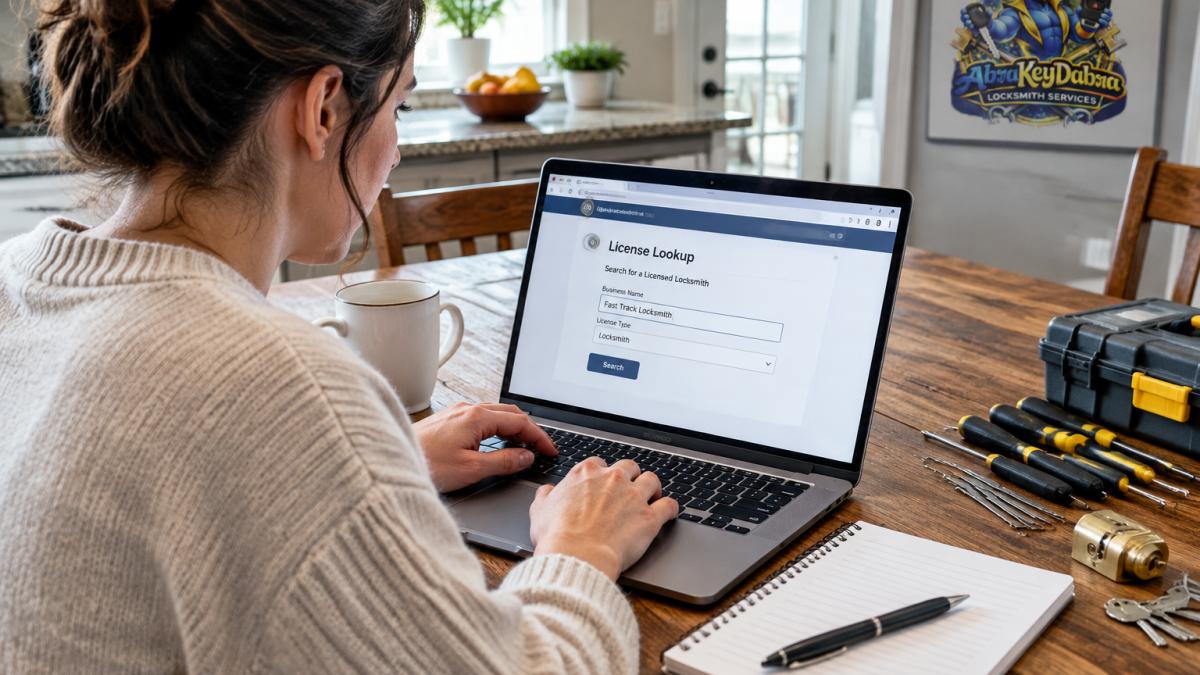
- Find your state's official licensing lookup page. Search your state name plus "locksmith license lookup" and confirm the site ends in .gov.
- Enter the locksmith's name or business name exactly as it appears on the truck, invoice, or card.
- Narrow the results by license type if the tool allows it.
- Open the record and read every field, not just the status.
- Save or screenshot the record with the date you checked it.
Searching by Name, Company, or License Number
Start with the name on your quote. If that returns nothing, try the business name or a license number if the technician gave you one. Search with fewer words first, since a long name can miss a match.
If results show several people with similar names, compare the city, the license type, and the status. Do not assume the first match is your technician.
Confirming the License Is Active and Matches the Provider
A record can exist and still not be valid. Look for these details:
- Status: It should say active or current, not expired, suspended, or revoked.
- Expiration date: Make sure it has not passed.
- Name match: The licensed name should match the person or company showing up.
- Address: The business address should be a real local location.
If the name on the record does not match the technician, ask why. A company may send employees under its license, but you should be able to confirm that relationship. Ask the technician to state, in writing, the name and license number under which the company operates, and compare it to the record.
Interpreting Records That Are Expired, Suspended, or Mismatched
A record that is not clean is not automatically a dealbreaker, but it changes what you should do next:
- Expired: Ask whether a renewal is pending and request proof. Do not authorize work until the status shows active.
- Suspended or revoked: Treat this as a stop sign. Ask the technician to explain, and do not let work begin until you have verified the current status directly with the agency.
- Inactive: Inactive often means the license exists but is not currently valid for work. Confirm with the agency what "inactive" means in that state.
- Name or address mismatch: A mismatch between the record and the person or business in front of you is the most common red flag. Ask for identification and a written explanation of the relationship between the licensed entity and the technician.
- No results: The database may be incomplete, the name may be spelled differently, or the locksmith may not be licensed. Try alternate spellings, the business name, and the license number before concluding the license does not exist.
What to Do When the Database Is Inconclusive
If the lookup tool returns nothing or the record is ambiguous, do not guess. Call the licensing agency directly and ask them to confirm the status of the name or license number.
Watch out: some lookup tools may update on a delay, so a recently renewed license may still show as expired.
The core steps for checking a locksmith's license online are summarised below.
| Step | What to do | Note |
|---|---|---|
| 1 | Find your state's official lookup page | Confirm the site ends in .gov |
| 2 | Enter the name exactly as shown on the quote | Use the business name or license number if needed |
| 3 | Narrow results by license type | Check the type covers the work |
| 4 | Read every field in the record | Not just the status |
| 5 | Save or screenshot the record | Note the date you checked |
Questions to Ask Before Hiring a Locksmith
Even after a license check, ask these questions before you agree to any work:
- What is your total price, including travel and service fees?
- What is your company's street address?
- What is your license number, and can I check it myself?
- Are you insured, and will you show proof?
- Will you give me a written quote before you start?
A reputable locksmith will answer these without hesitation. If someone avoids the questions, treat that as a warning sign.
Locksmith Scam Warning Signs and What to Do Next
Watch for these common red flags:
- A phone quote that is much lower than the price you are later charged
- A company name with no local address or a P.O. box only
- A technician who refuses to show a license or identification
- Pressure to drill a lock when a simpler option exists
- Cash-only demands with no receipt
If you spot these signs, do not let the technician start work. Ask for a written, itemized quote. If the price changes, you can refuse payment and call another provider. Report suspected fraud to your state attorney general's consumer protection office.
Keep the quote, the technician's name, and the vehicle details in case you need to file a complaint.
Booking Verified Locksmith Service in Evansville
Once a locksmith checks out, you can book with confidence. Abra Key Dabra Locksmith Services is licensed and insured and serves homeowners and businesses in the Greater Evansville area. For current pricing or a quote, contact us through our website.
Frequently Asked Questions
Do locksmiths have to be certified?
It depends on where you live. Many states require locksmiths to hold a state license, and some require background checks, written exams, or proof of insurance. A small number of states do not license locksmiths at all. Check your state's licensing board or attorney general's consumer protection office to find out which rules apply. Even where certification is optional, a provider who is licensed, insured, and willing to show identification and a business name is usually a safer choice than one who is not.
How can I check a locksmith license online?
Start with your state's official licensing board or professional licensing website. Most states offer a public search where you can enter a name, business name, or license number. Confirm the license type matches the work you need, check that the status is active and not expired, and make sure the name on the license matches the person or company arriving at your door. If the state has no online search, call the licensing board directly and ask them to confirm the license.
What should I do if my state does not require locksmiths to be licensed?
If your state does not license locksmiths, you cannot verify a license, so verify the business instead. Ask for the company's legal name and address, check that it is registered with your state's secretary of state, and confirm it carries liability insurance. Ask for a written estimate before work begins and request a receipt that lists the business name, address, and phone number. Local business reviews and a check with your city or county consumer office can also help.
What other credentials should I check before hiring a locksmith?
Beyond a state license, look for proof of general liability insurance, a registered business name, and a physical business address rather than only a phone number. Some locksmiths also hold certifications from professional associations, which can indicate ongoing training. A local business registration confirms the company exists, but it does not show technical competence, so pair it with the license check and ask for references or recent reviews.
