Last Updated: November 18, 2026
Quick Summary
Choose a safe lock by matching it to your parent's grip, dexterity, vision, and memory, since the right safe lock is one they can work on a bad day. A single-cylinder deadbolt with a large thumb-turn and lever handle suits most homes, while keypads help those who forget keys.
- Watch how your parent moves through the day before shopping for hardware.
- Replace round knobs with lever handles, which are easier on the hands.
- Add a door alarm before adding any physical barrier for dementia wandering.
- Avoid double-cylinder deadbolts that need a key to open from the inside.
- Every keypad and smart lock should have a mechanical override or power terminal.
Table of Contents
- Start With an Honest Assessment of Abilities and Routines
- The Best Door Locks for Elderly Adults Balance Easy Use and Real Security
- The Best Door Locks for Dementia Patients Address Wandering and Confusion
- How to Keep Dementia Patients From Opening Doors Without Trapping Them
- Senior-Friendly Smart Locks and Keypad Options Worth Comparing
- Book a Professional Lock Assessment and Installation
- Frequently Asked Questions
Start With an Honest Assessment of Abilities and Routines
Choosing a safe lock for an elderly parent starts with watching how they actually move through their day, and the right safe lock is the one they can work on a bad day. At Abra Key Dabra Locksmith Services, we tell families the right lock is the one your parent can work on a bad day, not just a good one.
Grip, Dexterity, Vision, and Memory: What Each Means for Lock Choice
Four abilities drive most lock decisions:
- Grip strength: A weak grip struggles with small keys and stiff deadbolts. Lever handles and larger thumb-turns help.
- Dexterity: Arthritic fingers fumble keyways and tiny buttons. A keypad with big, raised buttons is easier than a key.
- Vision: Low vision makes keyholes and small dials hard to find. Illuminated keypads and high-contrast hardware help.
A common mistake is buying the most advanced lock available. The best door locks for elderly adults match the person's real abilities.
Living Situation and Who Else Needs Access
Who else comes through the door shapes the choice as much as your parent's abilities. A caregiver, visiting nurse, or daily family member needs reliable entry, and emergency responders may need fast access during a crisis.
Ask three questions before you shop:
- Does your parent live alone or with someone?
- Who needs regular access, and how often?
- What happens if your parent cannot reach the door?
The answers point toward a keyed lock with a securely kept spare key, a keypad with a shared code, or a smart lock you can manage remotely.
The Best Door Locks for Elderly Adults Balance Easy Use and Real Security
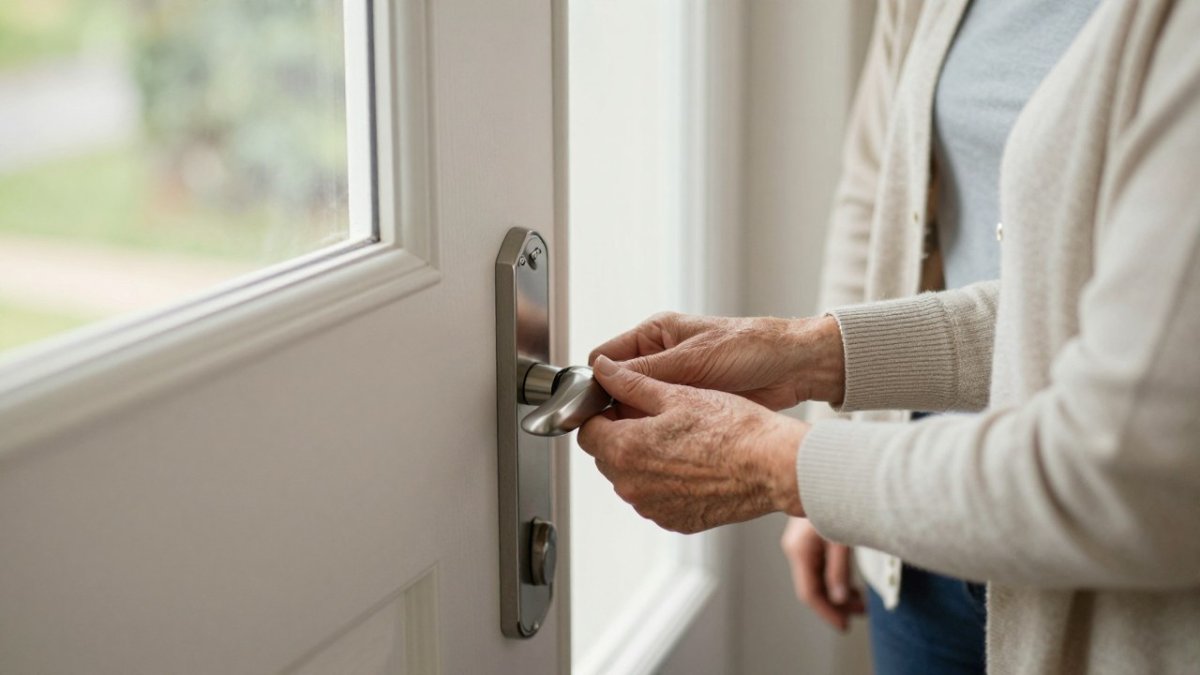
The best door locks for elderly adults combine a smooth, easy-to-turn mechanism with solid entry security. That usually means a single-cylinder deadbolt with a large thumb-turn inside and a lever handle below it, so one motion opens the door.
Here is how the main lock types compare for an older adult:
| Lock Type | Ease of Use | Security Level | Best For |
|---|---|---|---|
| Keyed deadbolt + lever | Easy with a key | High | Most homes |
| Thumb-turn deadbolt | Very easy inside | High | Single-door entries |
| Keypad lock | No key needed | Medium to high | Forgetful key users |
| Smart lock | App or code entry | Medium to high | Remote family access |
Two upgrades make a real difference: replace round knobs with lever handles, which are easier on the hands, and add a quality deadbolt if the door only has a spring latch. A door chain or secondary lock adds protection when someone answers the door.
For homeowners ready to upgrade, our residential lock replacement service covers worn or outdated hardware, and our high-security lock options help families weigh stronger protection without losing ease of use.
The Best Door Locks for Dementia Patients Address Wandering and Confusion
The best door locks for dementia patients slow an unsupervised exit without turning the home into a trap. The goal is not to lock a person in, but to add a moment of delay and a cue that redirects attention while keeping the door openable in an emergency.
Families often ask how to keep dementia patients from opening doors. The honest answer: no lock should make the door impossible to open from the inside. Match the measure to the condition's stage and the home's layout.
Match the Measure to the Stage
Families should escalate gradually rather than jumping to the most restrictive hardware.
- Early stage, mild confusion: Start with cues, not hardware. A covered knob, a curtain over the door glass, or a "Back in a minute" sign can reduce the urge to leave. A door alarm or motion sensor alerts a caregiver without restraining anyone.
- Middle stage, repeated exit attempts: Add a secondary latch placed high or low, out of easy sight, so it slows an exit without blocking it. Pair it with a familiar routine and a calm redirect.
- Later stage, persistent wandering: Combine a secondary latch with a door alarm and a caregiver check-in schedule. Keep the primary deadbolt a single-cylinder thumb-turn so the door still opens in one motion from inside.
Wandering is a safety concern, not a discipline problem. Talk with your parent's doctor, and treat the lock as one part of a broader safety plan.
Hardware Mechanics That Actually Slow an Exit
Not every secondary device works the same way. Here is what each does in practice:
- Door chain: Slides into a track and limits how far the door opens. Easy to install, but a determined person can defeat it, and it can jam if the door slams.
- Door guard or swing bar: A hinged bar that limits opening to a few inches. More robust than a chain and easier for a caregiver to release from outside with a key.
- Flip latch or barrel bolt: A sliding bolt placed high or low. Simple and reliable, but it must be reachable by a caregiver and must not replace the primary egress lock.
Watch out: a secondary latch placed too high for a caregiver to reach quickly can delay emergency entry. Test the release motion from both sides before you rely on it.
Privacy, Consent, and Autonomy
Adding locks to a parent's home is a decision about their independence, not just their safety. Involve your parent wherever possible: explain what the device does, why it is being added, and how it can be removed.
Avoid measures that unnecessarily limit independence. If your parent can still safely answer the door with a caregiver nearby, a door alarm may be enough.
A Quick Staged Checklist
- Confirm the primary deadbolt is a single-cylinder thumb-turn that opens in one motion from inside.
- Add a door alarm before adding any physical barrier.
- Add a secondary latch only if exit attempts continue, and place it where a caregiver can release it quickly.
- Test the full exit path with your parent, a caregiver, and a visitor playing the role of an emergency responder.
- Review the setup every few months as abilities change.
How to Keep Dementia Patients From Opening Doors Without Trapping Them
Balancing wandering prevention with emergency egress is the hardest part of this decision. Any lock you add must still let your parent, a caregiver, and an emergency responder get out and in quickly. That rules out deadbolts that need a key on the inside.
Fire Safety, Emergency Egress, and Local Code Considerations
Fire safety should guide every choice. In a fire, seconds matter, and a door that needs a key to open from the inside can cost precious time.
Local building and fire codes set the rules for egress doors and vary by property type. Before installing anything unusual, check with your local code office or ask a licensed locksmith to confirm the door meets egress requirements.
Senior-Friendly Smart Locks and Keypad Options Worth Comparing
Senior-friendly smart locks and keypads remove the key from the equation, which helps with grip, dexterity, and memory. A keypad lets your parent enter a code instead of fumbling for a key, and a smart lock lets family manage access from a phone.
The difference between a good pick and a frustrating one usually comes down to failure modes: what happens when the battery dies, the code is forgotten, or the app loses connection. Compare options against those criteria before you buy.
Side-by-Side Comparison by Accessibility and Failure Mode
| Criterion | Keypad Lock | Smart Lock |
|---|---|---|
| Operation | Code on large raised buttons | Code, app, or auto-unlock |
| Backup access | Physical key override on most models | Physical key override or external power terminal |
| Battery failure | Low-battery warning; key override | Low-battery warning; key override or jump terminal |
| Lockout risk | Forgotten code | Forgotten code, dead battery, Wi-Fi or hub outage |
| Caregiver usability | Shared code, easy to change | Remote codes, temporary access, activity log |
| Installation | Usually replaces existing deadbolt | Often needs hub or bridge; may need pro fitting |
| Best for | Forgetful key users, simple households | Families managing access from a distance |
What to Check Before You Buy
- Backup key or power terminal: Every keypad and smart lock should have a mechanical override or an external power point. Without one, a dead battery becomes a lockout.
- Button size and contrast: Look for raised buttons and high-contrast numbers. Small flush buttons defeat the purpose for arthritic or low-vision users.
- Code simplicity: A four-digit code your parent can remember beats a longer code they write down and lose. Change it only when needed.
Watch out: a smart lock that depends on an app your parent cannot operate can leave them stranded at the door. Make sure the physical key or code path works without the phone.
For deeper front-door picks, see our guide to the best smart lock for a front door, and before you commit, read what smart lock installation really costs so you can compare doing it yourself with hiring a pro.
Book a Professional Lock Assessment and Installation
A professional assessment takes the guesswork out of the decision. A licensed technician can check the door, frame, and existing hardware, then recommend a lock that fits your parent's abilities and meets egress needs.
At Abra Key Dabra Locksmith Services, our licensed and insured technicians handle residential lock installation and upgrades across the Greater Evansville area. When you are ready, request a free quote and we will help you plan the next step.
The right lock protects your parent without taking away their independence, and getting the balance right is worth a professional opinion.
Frequently Asked Questions
What are the best security locks for dementia patients?
Locks that conceal the thumb-turn or require a key or code tend to work best for dementia patients, because they interrupt the automatic habit of simply turning a knob. A double-cylinder deadbolt or a keypad lock can slow an unsupervised exit, but it must still be openable from inside during a fire. Pair the lock with door alarms or motion sensors, and keep a spare key or access code with a caregiver. A locksmith can confirm the setup meets egress rules for your area.
Are keypad or smart locks easier for seniors to use?
For many older adults, a keypad or senior-friendly smart lock is easier than fumbling with small keys, especially with arthritis or reduced vision. Look for large backlit buttons, audible feedback, and a backup key override in case the battery dies. Smart locks also let family members issue temporary access codes to caregivers and check whether the door was opened. The trade-off is battery maintenance and a learning curve, so practice the code together before relying on it.
How can I keep an older adult safe while preserving emergency exit access?
Any interior lock you add must open from the inside without a key, so the person can leave quickly in a fire. Use door alarms or caregiver alerts rather than bars or wedges that block the exit. Keep a spare key or code with a trusted neighbor or care worker, and test the lock with the person present. Local fire codes generally prohibit locks that trap occupants, so have a professional check the installation before you rely on it.
Should I add an inside door lock to my parent's bedroom?
An inside lock can give privacy and a sense of control, which matters for dignity and autonomy. Choose a privacy lock that opens from the outside with a coin or emergency tool, and make sure it cannot be engaged in a way that traps the person during an emergency. Talk with your parent about why the lock is there before installing it. If wandering is the concern, a door alarm or a lock on the exterior door is usually more effective than locking the bedroom.
