Last Updated: November 27, 2026
Quick Summary
A commercial door closer is repaired by a locksmith who inspects the unit, adjusts or replaces faulty parts, and tests closing speed and latch. Start by describing the symptom, such as slamming, dragging, or failing to latch, and note any oil leak. Repair fits when the body is sound; replacement is usually needed when oil is leaking.
- Describe the symptom and note whether the door latches and whether the closer leaks oil.
- Oil visible on the closer body or floor means a seal has failed, and adjustment will not fix it.
- Door slams shut usually means the sweep or latch valve is open too far or the fluid has thinned.
- Do not remove the closer body, drill new mounting holes, or back out adjustment valves past their stops.
- Fire-rated doors need a qualified technician, since altering settings can stop the door from latching on its own.
Table of Contents
- How Do I Get a Commercial Door Closer Repaired in Evansville?
- Common Commercial Door Closer Types and What They Do
- Commercial Door Closer Replacement Versus Repair: Deciding What Your Property Needs
- Frequently Asked Questions
How Do I Get a Commercial Door Closer Repaired in Evansville?
A commercial door closer is repaired by a locksmith who inspects the unit, adjusts or replaces faulty parts, and tests closing speed and latch.
Start by calling and describing the symptom: slamming, dragging, not closing fully, or staying open usually points to a specific problem. Note whether it latches and whether the closer leaks oil.
You can reach Abra Key Dabra Locksmith Services at (812) 625-2585 for service. page covers emergency lockout and on-site service options in Evansville.
Fire-rated and exit doors need extra care. NFPA 80 standard for fire doors and other opening protectives
Common Commercial Door Closer Types and What They Do
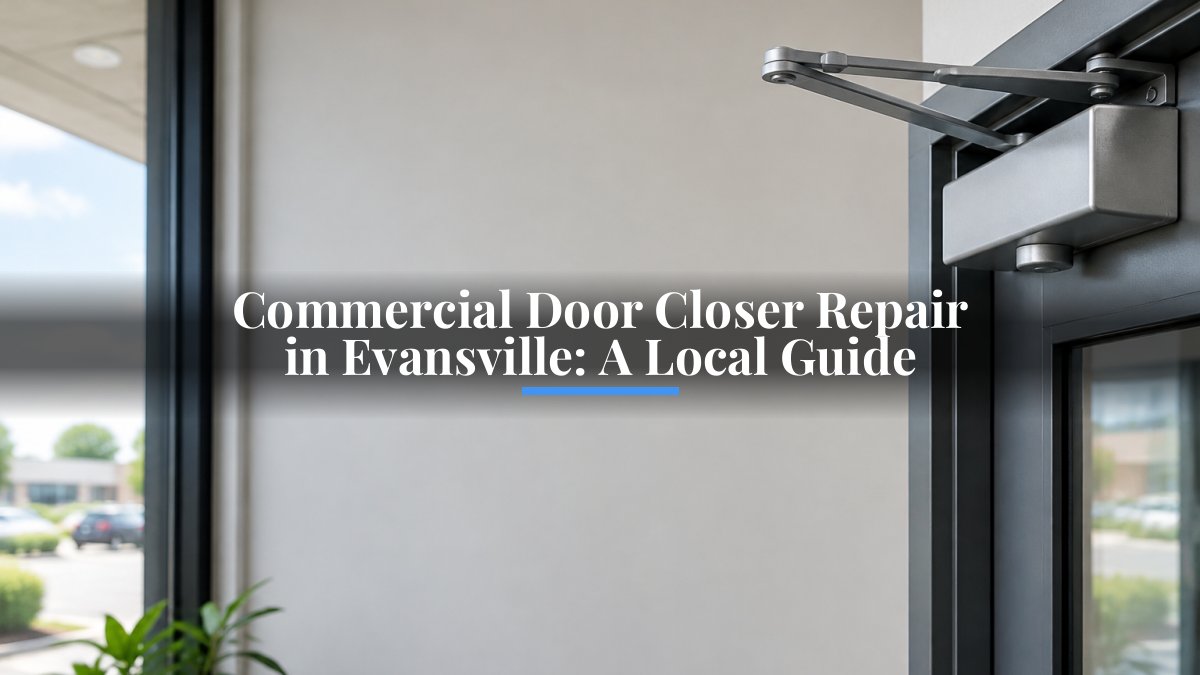
Most commercial doors use one of three closer types; knowing which you have helps you describe the problem.
- Surface-mounted closer. Body on the door face, arm on the frame, most common and easiest to service.
- Concealed closer. Body sits inside a pocket in the door or frame; requires door or trim removal to service.
- Floor closer (floor spring). Mechanism sits in the floor beneath a pivot; suits heavy and all-glass doors but is the most labor-intensive to repair.
All three control closing speed with hydraulic fluid through internal valves. Adjustment screws set the sweep (closing speed through most of the travel), the latch (the final few inches pulling the door into the frame), and the backcheck (resistance to being thrown open); some models add delayed action for carts and wheelchairs.
- Door slams shut. Sweep or latch valve is open too far, or fluid has thinned with age.
- Door drifts or won't close fully. Sweep is too slow, arm is loose, or the closer is losing hydraulic pressure.
- Door is hard to open. Backcheck is too aggressive, or the closer is undersized.
- Oil visible on the closer body or floor. A seal has failed; adjustment won't fix a leaking unit.
- Door won't latch. Latch speed is too fast, the strike is misaligned, or the arm has slipped on its spindle.
Before calling, staff can safely confirm the door swings freely with the closer disconnected (if it binds, the hinge or pivot is the problem), check that arm screws are tight, and note any leak. Do not remove the closer body, drill new mounting holes, or back out adjustment valves past their stops.
On a fire-rated door, changing sweep, latch, or backcheck settings can keep the door from latching on its own, defeating its purpose; adjustments should be made by a qualified technician and verified against the door's label.
page explains installation and repair options for exit door push bars, which often work alongside a closer.
The symptom you see usually points to one of these adjustment or mechanical problems.
| Symptom | Likely cause | Fix |
|---|---|---|
| Door slams shut | Sweep or latch valve open too far, or fluid thinned with age | Adjust valves or service the unit |
| Door drifts or won't close fully | Sweep too slow, arm loose, or lost hydraulic pressure | Tighten arm or adjust sweep; replace if pressure is lost |
| Door is hard to open | Backcheck too aggressive or closer undersized | Adjust backcheck or install a correctly sized closer |
| Oil visible on body or floor | Seal has failed | Replace the closer; adjustment will not fix a leak |
| Door won't latch | Latch speed too fast, strike misaligned, or arm slipped on spindle | Adjust latch speed, align strike, or reseat the arm |
Commercial Door Closer Replacement Versus Repair: Deciding What Your Property Needs
Repair usually fits when the closer body is sound and the problem is mechanical or a matter of adjustment; replacement is usually better when the unit has lost hydraulic integrity or its mounting is compromised.
-
The arm is loose, bent at the shoe, or has slipped on the spindle.
-
The door latches too fast or too slowly and the valves still respond.
-
Mounting screws have worked loose but the holes are intact.
-
The closer is a few years old and shows no fluid loss.
-
Oil is visible on the body, arm, or floor; a leaking seal cannot be reconditioned in the field.
-
The closer no longer holds a setting after adjustment, pointing to internal valve or piston wear.
-
The arm is bent, the spindle is stripped, or the body is cracked.
-
The closer is undersized and keeps failing the same way.
-
Mounting holes are stripped or the door or frame has rot, rust, or impact damage.
-
Replacement parts are no longer available.
A closer matched to a light interior door will fail early on a heavy exterior door, and no adjustment fixes an undersized unit; the door's hardware schedule or the closer's model label shows the size and mounting pattern needed.
On a fire door, the closer must be listed for the assembly and reliably latch the door on its own; swapping in an unlisted closer or altering the arm can void the rating. On an accessible route, opening force and closing time are regulated, so a closer that is too strong or too fast can create a compliance problem, have a qualified technician confirm the replacement matches the door's label rather than matching by appearance.
Before you decide, compare full replacement with other options. page lays out the trade-offs, and article explains what a commercial lock or hardware installation involves.
Our team can inspect the door and recommend repair or replacement. Contact Abra Key Dabra Locksmith Services for a quote in Evansville. Our technicians are licensed and insured, and page lists our Evansville service details.
Ready to fix a sticking or slamming commercial door? Call Abra Key Dabra Locksmith Services at (812) 625-2585 for prompt commercial door closer repair in Evansville.
Frequently Asked Questions
How can I tell if a commercial door closer needs repair?
Common signs include a door that slams shut, closes too slowly, fails to latch, or stays partly open. Oil leaks around the closer body, grinding noises, and loose mounting screws also point to a problem. If the door does not close consistently after basic checks, have a professional inspect the closer, arm, and door alignment.
Can a locksmith repair or replace a commercial door closer?
Closer adjustment affects both safety and accessibility, so it is best handled by a trained technician.
Why is my commercial door lock not working when the closer seems fine?
A commercial door lock may fail to engage because of latch misalignment, worn strike plates, or a door that has shifted in its frame. Sometimes a closer that closes the door too hard or too softly prevents the latch from seating properly. Because the lock and closer work together, a technician should check both components at the same visit.
